
Shift, Shave, Maximize: How Three Layers Cut a Lab Building’s Energy Bill by 42%
Shift, Shave, Maximize: How Three Layers Cut a Lab Building’s Energy Bill by 42%
Efficiency is the foundation of any energy strategy for a critical environment. In labs, where airflow and safety requirements must both be met, success requires deep expertise in critical environments. However, achieving efficiency in a lab is not where a project should end. Efficiency reduces how much energy a building uses, but when it comes to utility bills, there are additional opportunities to save by addressing when a building uses energy.
That’s why every building should be approaches as a stack: shift the load down with efficiency, shave the peaks with demand response, then maximize the result with a right-sized battery. Each layer builds on the one before it and captures savings the others can’t reach. In a model of a 1 MW-peak building, the three layers together cut annual cost from $850k to $490k, 42% lower. Stop after efficiency, and about $232k a year stays on the table.
The problem: an expensive 3 PM peak
Our example building draws 400 kW overnight and peaks at 1,000 kW around 3 PM, right when the grid peaks. That timing costs money: about 41% of the $850k baseline bill ($348k) comes from demand and capacity charges set by a handful of peak hours.
Three layers stacked example
Shift with efficiency: -$128k a year. Controls optimization, retro-commissioning and equipment upgrades lower the whole load curve about 15%. Energy use, peak demand and the capacity charge all fall together.
Shave with demand response: -$71k a year. Demand response curtails load on utility event days and on the days that set each month’s peak. It has little effect on annual kWh but a large effect on peak-based charges, because those charges are set by just a few hours a year. This approach can reduce demand charges by 30-70%.
Maximize with battery energy storage: -$161k a year. A 650 kW battery discharges from 1 to 5 PM, taking grid draw at the 3 PM peak to near zero and wiping out the capacity charge.
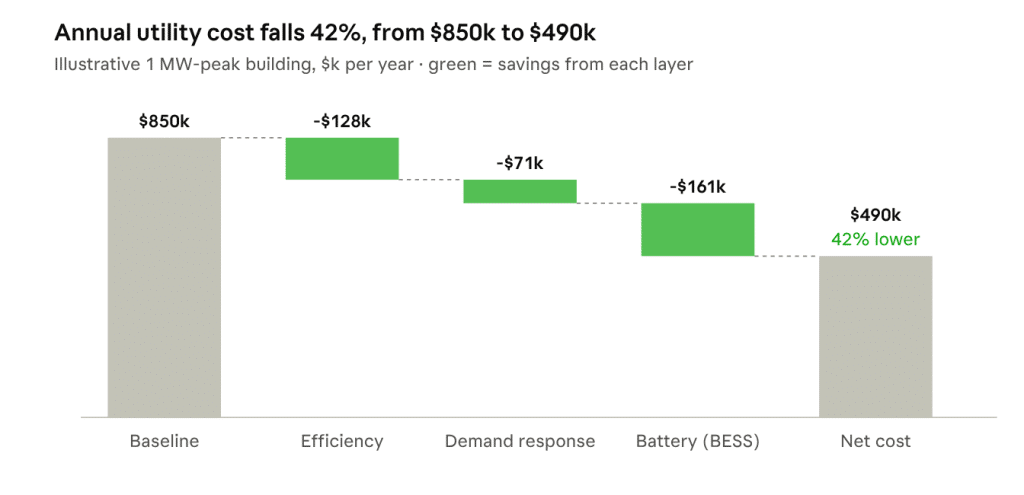
Each layer makes the next one work better. Efficiency and demand response shrink the peak, so the battery can be smaller.
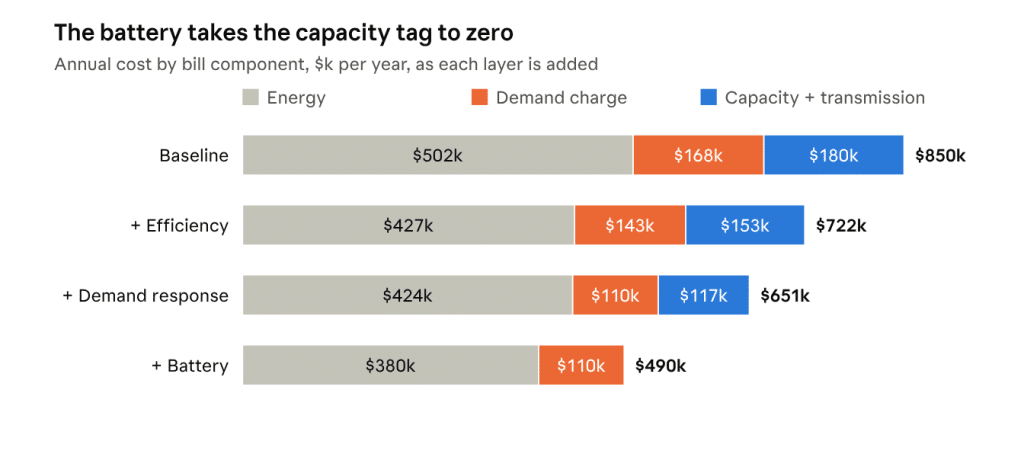
Efficiency lowers what you use. Demand response and storage lower what you pay for when you use it. Thrive Buildings models the stack with your own tariff and interval data, with no upfront capital required.
Model assumptions: illustrative 1 MW-peak site. Energy $0.12/kWh on-peak, $0.065 off-peak; demand $14/kW-month; capacity + transmission $180/kW-year; DR on ~20 days per year; battery 88% round-trip efficiency. DR program revenue not included.
Back to BlogCopyright © 2026 |Thrive Buildings Inc.| Site by CHAMP Digital